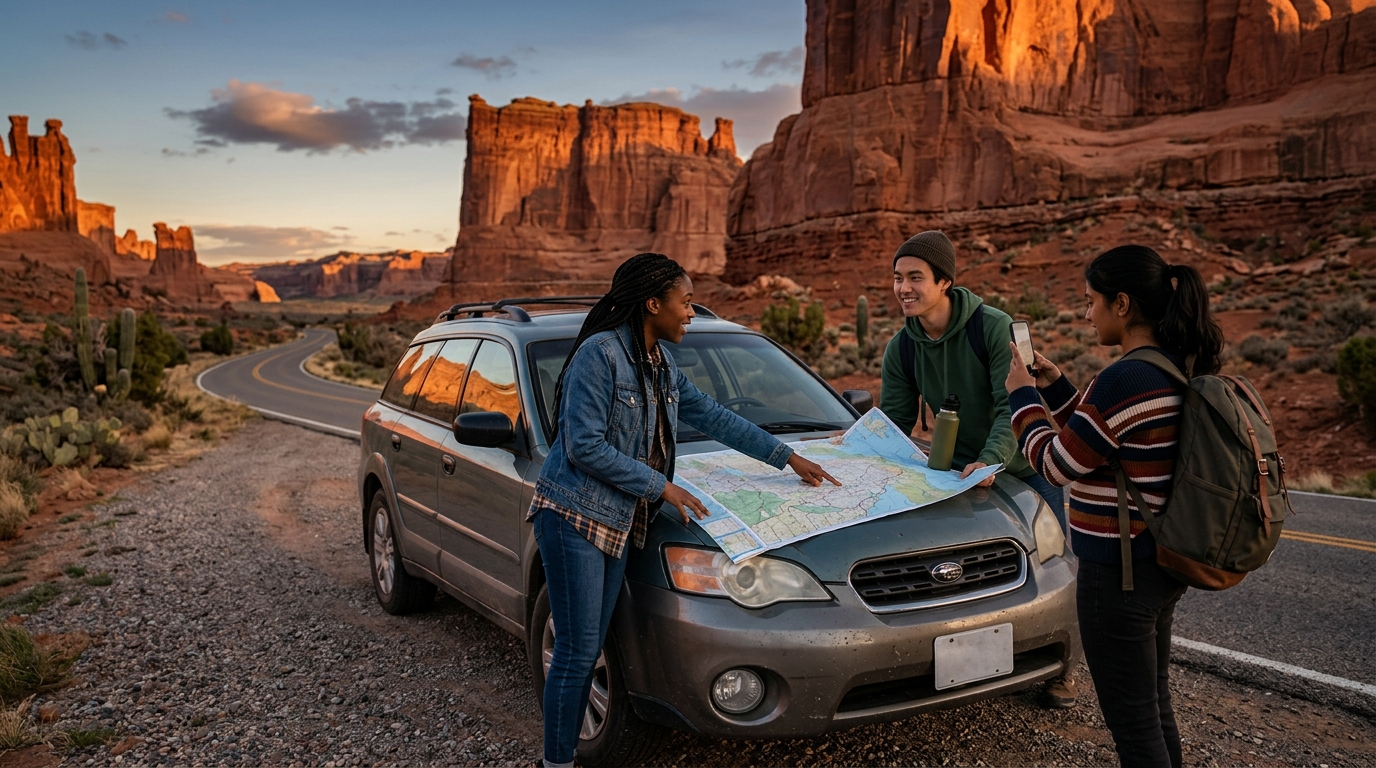
US Road Trip on a Student Budget — Routes, Tips & Hidden Costs
A road trip is the most American way to travel. The interstate highway system connects every corner of the country, gas is relatively cheap compared to Europe or Asia, and the landscapes change dramatically every few hours. You can cross deserts, mountains, forests, and coastlines in a single trip.
The best part? A road trip can be surprisingly affordable — if you plan it right.
Budget Planning
The Real Costs
For a group of 3-4 people sharing a car, here's what a typical 7-day road trip costs per person:
| Expense | Budget/Person | Notes |
|---|---|---|
| Rental car | $15-30/day | Split 3-4 ways |
| Gas | $10-20/day | Depends on distance and vehicle |
| Accommodation | $15-40/night | Camping to motels |
| Food | $20-35/day | Groceries + occasional restaurant |
| Activities | $5-15/day | Parks, attractions |
| Total | $65-140/day | $450-1,000/week per person |
Key insight: The difference between a $450 trip and a $1,000 trip is almost entirely accommodation and food. The car and gas are relatively fixed.
Gas Math
- Average US gas price: $3.20-3.80/gallon (varies by state — California is $4.50+, Texas is $2.80)
- Average rental car: 28-32 MPG
- Rule of thumb: $0.12-0.15 per mile driven
- A 2,000-mile trip costs roughly $250-300 in gas, or $60-75 per person in a group of 4
Save on gas: Use GasBuddy app to find the cheapest stations along your route. Costco gas is usually $0.20-0.40/gallon cheaper (members only). Avoid highway gas stations — exit and drive 1-2 minutes to find cheaper options.
Best Routes for Students
California Pacific Coast Highway (PCH)
Route: San Francisco → Big Sur → Santa Barbara → Los Angeles Distance: ~470 miles | Duration: 3-5 days Cost: Budget $400-600/person (5 days) Highlights: Bixby Bridge, McWay Falls, Hearst Castle, Morro Bay, Santa Barbara wineries Tip: Drive southbound for the ocean-side views. Camp at state parks along the coast ($25-45/night).
Southwest Desert Loop
Route: Las Vegas → Grand Canyon → Monument Valley → Zion → Bryce Canyon → Las Vegas Distance: ~1,000 miles | Duration: 5-7 days Highlights: Three national parks, Navajo Nation, Horseshoe Bend, Antelope Canyon Tip: Carry extra water (1 gallon/person/day minimum). Gas stations are sparse on the Navajo Nation — never let your tank drop below half.
East Coast Classic
Route: Boston → New York City → Philadelphia → Washington, D.C. Distance: ~450 miles | Duration: 5-7 days Highlights: Freedom Trail, Times Square, Liberty Bell, Smithsonian museums (free!) Tip: Parking in these cities is expensive ($30-60/day). Use Park & Ride lots outside the cities and take public transit in.
Southern Charm
Route: Nashville → Memphis → New Orleans Distance: ~550 miles | Duration: 4-5 days Highlights: Country Music Hall of Fame, Beale Street, French Quarter, live jazz Tip: Food is the star here — budget extra for Nashville hot chicken, Memphis BBQ, and New Orleans beignets. All three cities are walkable downtown.
Pacific Northwest
Route: Portland → Columbia River Gorge → Crater Lake → Bend → Seattle Distance: ~700 miles | Duration: 5-7 days Highlights: Multnomah Falls, Crater Lake (deepest lake in US), Mount Rainier views Tip: Best June-September. Rain is likely outside summer. Free camping on national forest land (dispersed camping — no facilities, no fee).
Accommodation on a Budget
Free/Nearly Free Options
- Dispersed camping on public land: Free camping on National Forest and BLM (Bureau of Land Management) land. Use the iOverlander or FreeRoam apps to find spots. No facilities — bring everything you need.
- Walmart parking lots: Many Walmart locations allow free overnight parking. Not luxurious, but free and safe. Check the Walmart Overnight Parking app.
- Rest stops: Some states allow overnight parking at highway rest areas (check state rules — not all allow it).
Budget Options
- National/state park campgrounds: $15-35/night. Reserve on Recreation.gov (national) or state park websites. Popular sites book months ahead.
- KOA campgrounds: $30-50/night. Showers, laundry, sometimes a pool. Good for groups.
- Motel 6 / Super 8: $50-80/night. Clean, basic, no frills. Split 2-4 ways, it's very reasonable.
- Airbnb: Great for groups. A 2-bedroom Airbnb split 4 ways can be $20-40/person/night.
Food Strategy
The Cooler System
Buy a $15-25 cooler at Walmart and stock it at the start of your trip:
- Bread, peanut butter, jam — lunches for days
- Fruit (apples, bananas, oranges)
- Deli meat and cheese
- Hummus and carrots
- Granola bars
- Water bottles (refill at rest stops)
Cost: $30-40 for 3-4 days of lunches and snacks for the whole car.
Eating Out Smart
- Breakfast: Skip restaurants. Grocery store bagels + cream cheese ($5 for the group) or gas station coffee ($1-2).
- Lunch: Picnic from your cooler at scenic overlooks — free and more memorable than any restaurant.
- Dinner: One restaurant meal per day is a good balance. Look for local spots, not chains. Ask locals for recommendations.
Driving Safety
Fatigue
- Driver rotation: Switch drivers every 2-3 hours. Fatigue-related crashes spike after 3+ hours of continuous driving.
- Rest stops: Take a 15-minute break every 2 hours. Walk around, stretch, get fresh air.
- Night driving: Avoid if possible, especially on unfamiliar rural roads. Wildlife (deer, elk) is active at dawn and dusk.
Winter Driving
If driving through mountain passes or northern states in winter:
- Check road conditions: CalTrans (California), CDOT (Colorado), or 511 for any state.
- Carry chains: Required on some mountain passes. Practice putting them on before you need them.
- Black ice: Invisible ice on roads, especially on bridges and shaded areas. If the temperature is near freezing, drive slower.
- Emergency kit: Blanket, flashlight, water, snacks, phone charger. If you get stranded, stay with your car.
Navigation
- Google Maps vs Waze: Google Maps has better offline maps; Waze has better real-time traffic and speed trap warnings. Download offline maps for your route before leaving.
- Cell dead zones: Large stretches of rural America have no cell coverage. Download your entire route offline. Carry a paper map as backup (gas stations sell them for $5-10).
Hidden Costs to Watch
- Toll roads: I-80 through Ohio/Indiana, Florida Turnpike, Northeast Corridor. Budget $20-50 in tolls for a cross-country trip.
- National park entrance: $35 per vehicle, or $80 for the annual pass (covers all parks for a year — worth it if visiting 3+ parks).
- Parking: Free in most small towns and parks. Expensive in big cities ($20-60/day). Use Park & Ride lots.
- One-way rental drop-off: $100-500+ fee. Try to return the car where you picked it up.
- Speeding tickets: $100-300+ depending on the state. Use cruise control to stay at the speed limit. Small-town speed traps are real.
Packing Essentials
- Cooler + reusable water bottles
- Phone mount for navigation
- USB car charger (multi-port)
- Downloaded offline maps
- Sunscreen and sunglasses
- First aid kit
- Blanket and pillow (for naps at rest stops)
- Reusable bags for groceries
- Flashlight or headlamp
- Cash ($50-100 — some rural areas are cash-only)
A road trip with friends is one of the best experiences you can have as a student in America. The open highway, the changing landscapes, the tiny towns with amazing diners — it's everything the movies promise. Budget wisely, share costs, and remember: the journey matters as much as the destination.